


Open Source Billing, in Production Since 2010
 Kill Bill: open source, Apache 2.0, free
 Aviate: enterprise features and Level 3 support
Last updated: October 2026
Is there free, open source billing software?
Kill Bill Open Source in Facts
- License
- Apache 2.0
- In production since
- 2010
- Source code
- github.com/killbill/killbill
- Cost
- Free, with no fee per transaction
- Language
- Java, with plugins in Java
 Java
Java - Databases
- MySQL, MariaDB or PostgreSQL
 MySQL
MySQL MariaDB
 PostgreSQL
 - Deployment
- Docker, Kubernetes or Tomcat, on your infrastructure
 Docker
 Kubernetes
 Tomcat
 - Admin UI
- Kaui, also open source
- Support
- Community help, no support or SLA. Level 3 support with Aviate
- Enterprise offering
- Aviate, a fixed annual fee, never a share of revenue
What Is Free, and What Aviate Adds
| Kill Bill open source | Aviate | |
|---|---|---|
| Billing | Catalog, subscriptions, usage, invoices, credits | Adds a catalog UI, Aviate Coupons, Aviate Wallet, Aviate Metering |
| Payments | Payment API, gateway plugins, retries, refunds, chargebacks | Adds payment settings in the Aviate interface |
| Tax | Tax plugins such as AvaTax, Vertex or Kintsugi | Adds Aviate Tax: rates per country and per product |
| Operations | Kaui admin UI, REST API, multi-tenancy | Adds the Aviate interface and Aviate Health |
| Support | Community help, no support or SLA | Level 3 support from the engineers, first response within 1 business day for a P1 |
| Cost | Free | A fixed annual fee, never a share of revenue. Pricing |
Run Kill Bill on Your Laptop
- Install Docker and Docker ComposeAllow at least 4 GiB of memory for Docker.
- Create a docker-compose.yml fileThree services: Kill Bill, Kaui and MariaDB. The getting started guide gives the file.
- Run
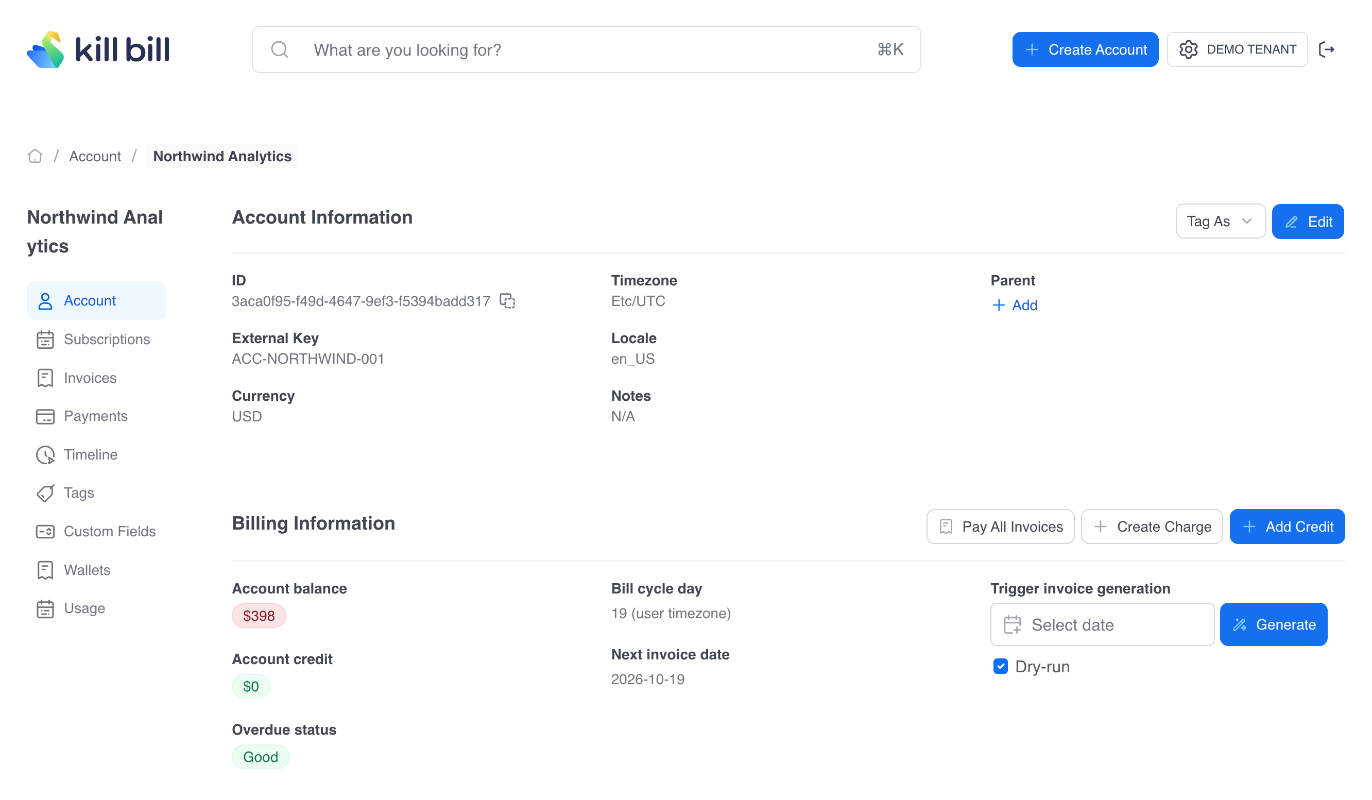
docker compose upAfter a couple of minutes, the Kill Bill API answers on port 8080 and Kaui on port 9090. - Create a tenant, a catalog and an accountThen subscribe the account to a plan and see the first invoice. Getting started guide
Open Source or Hosted SaaS Billing?
| Self-hosted open source | Hosted SaaS billing | |
|---|---|---|
| Who runs it | Your team, on your infrastructure | The vendor |
| Where data lives | In your database, in the region you choose | In the vendor's systems |
| Cost model | No license fee. You pay for hosting and your team's time | Often a share of revenue or a fee per invoice, so the bill grows with sales |
| Source code | Public. You can read, audit and change it | Closed |
| Custom logic | Plugins and code changes | Limited to what the vendor exposes |
| Upgrades | When you choose | When the vendor ships |
| Time to start | Longer: you install, integrate and operate it | Shorter: sign up and configure |
Open source billing fits when
- Billing volume is high, and a share of revenue would cost too much
- Billing data must stay on your infrastructure
- Your pricing or payment flows need custom logic
- You have engineers who can run a Java service
It is not the right fit when
- You have no engineering team to deploy and operate it
- You want a hosted tool that works the same day
- Your pricing is simple and your volumes are low
Why Choose Open Source for Billing?
Savings
No monthly fee, no yearly fee and no fee per transaction. Spend the budget on your own logic and plugins instead.

Flexibility
Test new pricing and billing models when you need to. No contract lock-in, no usage limits, no data query restrictions.

Stability
The software does not depend on one vendor's future. The code stays public, and the community can maintain it.

Control
Upgrade on your own timeline. Read every line of code, and validate configuration and code changes before production.

Open Architecture
Add your own logic through plugins. Connect your systems and the payment and tax vendors you choose.

Community
Users around the world share solutions on the mailing list and on GitHub. Someone may have solved your problem already.
Common Questions About Free Software

Why does it matter that Kill Bill is open source?
Anyone can download, study, change, run and share the code. Kill Bill is free to use: no monthly charge, no yearly charge, no fee per transaction.

What businesses use free software?
Startups and global enterprises alike. Open source has existed for decades: WordPress and LibreOffice are open source. See the Kill Bill use cases.

What can you do with Kill Bill?
- Install it on a computer, server or cloud, and bill customers or take payments.
- Change the code or add plugins for your sector and processes.
- As a consultant, adapt it for your clients.
You do not have to share your changes, although contributions are welcome.
Are there any rules?
Yes, the Apache License 2.0, one of the more permissive open source licenses. You can use Kill Bill commercially. You keep the copyright and license notices when you distribute it, and each contributor grants a patent license for their contributions.

Is free software untested or insecure?
The longer software runs, the more engineers read, test and fix it. Because the code is public, your own team can audit it for security reviews and financial controls. Kill Bill security advisories are posted on the community mailing list.

Is free software unsupported?
The community helps on the mailing list, without any SLA. For production support, Aviate includes Level 3 support from the engineers who build the platform, on a dedicated Slack channel. Support options
To learn more about open source, read the Open Source Initiative and Wikipedia.
Not a Starter Kit. A Production System.
Proven in PCI Environments
Kill Bill runs today in PCI DSS compliant companies. Card data is tokenized by the payment gateway, and Kill Bill keeps the token.
Multi-Tenant White-Label
One deployment can run many tenants, each with its own catalog, accounts and payment configuration.
Complex Billing Models
Usage-based billing (AI tokens, API calls), recurring fees, billing in advance or in arrears, proration and credits.
Your Payment Gateways
Open source plugins for Stripe, Adyen, Braintree and Hyperswitch, or your own plugin. Payment platform
 Stripe
 BraintreeHyperswitch
Your Tax Engines
Open source tax plugins for Avalara AvaTax, Vertex and Kintsugi compute tax on each invoice. Aviate Tax adds rates per country and per product. Tax compliance


 Kintsugi
Open Source Billing FAQ

Ready to Transform Your Billing?

Support

Kill Bill Community

Documentation
